In recent months, I have heard a recurring argument: that because Brookfield is a small town, local businesses should be given more flexibility when it comes to regulatory compliance.
I disagree.
Supporting local businesses and expecting compliance with public health and environmental regulations are not mutually exclusive. In fact, responsible businesses understand that regulations exist for a reason—to protect public health, public safety, natural resources, and the community as a whole.
Whether a business is located in a large city or a small rural town, the basic principles remain the same.
Brookfield is not unique in its size. Massachusetts has dozens of towns with populations similar to, or smaller than, ours, and those communities are still expected to comply with state public health, environmental, and safety requirements.
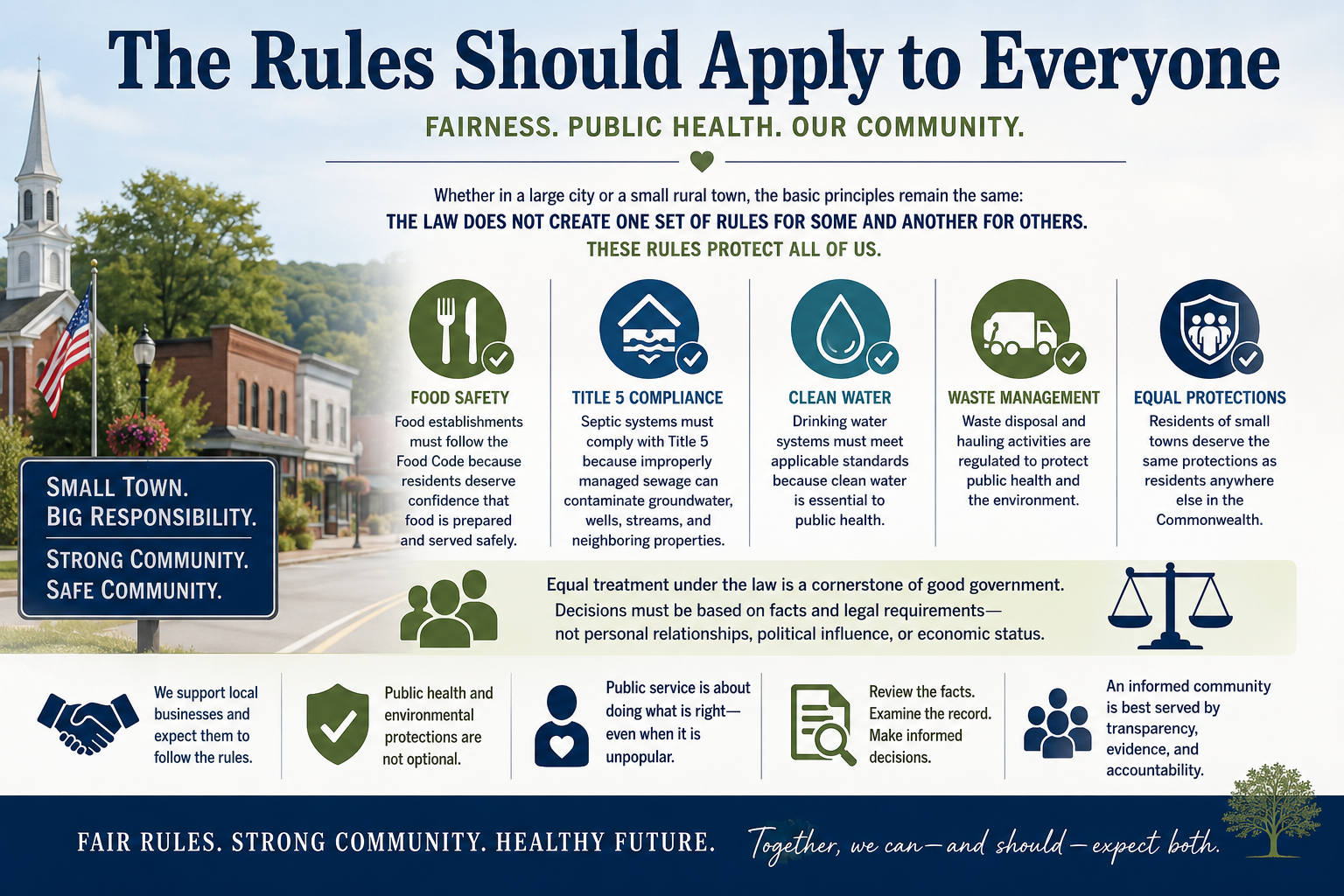
Food establishments must follow the Food Code because residents deserve confidence that food is prepared and served safely.
Septic systems must comply with Title 5 because improperly managed sewage can contaminate groundwater, wells, streams, and neighboring properties.
Drinking water systems must meet applicable standards because clean water is essential to public health.
Waste disposal and hauling activities are regulated to protect public health and the environment.
The law does not create one set of rules for large communities and another for small towns. These requirements are not arbitrary obstacles; they are safeguards that protect everyone.
Residents of small towns deserve the same protections as residents anywhere else in the Commonwealth.
Small towns are not immune from foodborne illness, groundwater contamination, environmental damage, or public health risks. In many ways, small towns can be more vulnerable because residents often rely on private wells, local waterways, and limited public resources.
The expectation should not be that regulations disappear when a business is popular, influential, or politically connected. The expectation should be that the rules are applied fairly and consistently to everyone.
Equal treatment under the law is a cornerstone of good government. Residents should be able to trust that permits, inspections, enforcement actions, and regulatory decisions are based on facts and legal requirements—not personal relationships, political influence, or economic status.
As a Board of Health member, I have always believed that our responsibility is to protect public health and apply regulations fairly. That means supporting businesses while also ensuring compliance with the standards that protect our community.
Local businesses are an important part of our town, and most work hard to comply with applicable requirements. Holding all businesses to the same standards is not anti-business. It is pro-fairness, pro-transparency, and pro-public health.
Brookfield deserves the same protections as any other community. Residents should not have to choose between supporting local businesses and expecting compliance with laws designed to protect their health and environment.
If insisting on fairness, regulatory compliance, and equal treatment under the law makes me unpopular with some people, I can accept that. Public service is not about avoiding criticism; it is about doing what is right for the community. I would rather face criticism for enforcing the rules fairly than remain silent when public health, environmental protections, and the public trust are at stake.
I encourage residents to consider not only the allegations being made, but also the context in which they are being made. Ask who is leading this effort, what relationships and interests may be involved, and what events preceded the recall campaign. Review the public record and reach your own conclusions based on facts rather than rhetoric.
An informed community is best served when decisions are based on evidence, transparency, and accountability.
We can—and should—expect both.
Sincerely,
Maureen Lepak
Supporting local businesses and expecting compliance with public health and environmental regulations are not mutually exclusive.